.png?strip=all)
.png?strip=all)

Filtres Trier les résultats
Rafraîchir Appliquer
 | The SEM pin stubs for the Zeiss and LEO SEMs, CrossBeams or SEM/FIB systems use a 6mm short pin. The pin diameter for all Zeiss SEM pin stubs is 3.2mm (1/8'') diameter. They are made from high quality, vacuum grade aluminium. The Zeiss SEM pin stubs are manufactured according to original specifications for the pin stubs and additional style are added to enable a wide range of applications. The most popular Zeiss pin stubs are the pin stubs with the 12.7 and 25.4mm top diameter. Most of the flat Zeiss SEM pin stubs have a 3.2mm platform height and a groove to enable easy holding and handling. |
 | The SEM pin stubs for the Zeiss and LEO SEMs, CrossBeams or SEM/FIB systems use a 6mm short pin. The pin diameter for all Zeiss SEM pin stubs is 3.2mm (1/8'') diameter. They are made from high quality, vacuum grade aluminium. The Zeiss SEM pin stubs are manufactured according to original specifications for the pin stubs and additional style are added to enable a wide range of applications. The most popular Zeiss pin stubs are the pin stubs with the 12.7 and 25.4mm top diameter. Most of the flat Zeiss SEM pin stubs have a 3.2mm platform height and a groove to enable easy holding and handling |
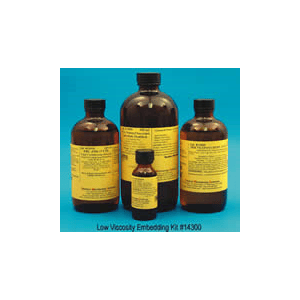 | Provides excellent penetration for embedding biological tissues and rapid infiltration. Easy to prepare. The hardness is adjusted by changing the proportion of the flexibilizer (DER 736). The blocks have good trimming and sectioning qualities. Thin sections are tough under the electron beam.
Spurr, A.R., (1969) J. Ultrastruct. Res. 26, 31-42 |
 | |
| |
| |
| |
 | The same as our Lowicryl complete kits but this new formulation allows you one stop embedding without all of the cumbersome preparation and mixing. This pre-mixed, ready to use resin, saves you time and minimizes chemical contact. MonoStep Lowicryl is ideal for use in immunohistochemistry and immunolabeling. Store at room temperature.
MSDS_14335
MSDS_14345
Storage : RT |
| Lowicryl resins are highly cross-linked acrylate-based embedding resins, designed for use over a wide range of embedding conditions. These resins provide low viscosity at low temperatures.
The K4M kit is usable to -35°C and is a polar (hydrophilic) medium, while the HM20 kit can be used down to -70°C and is nonpolar (hydrophobic).
Lowicryl's K11M and HM23 have properties similar to K4M and HM20, but can be used at temperatures 20 degrees lower than others: K11M at -60°C, HM23 at least -80°C. All of these resins are photopolymerized by long wavelength (360nm) ultraviolet light. Since the initiation of the polymerization is largely independent of temperatures, blocks may be polymerized at the same temperatures used for infiltration. The resin may also be chemically polymerized at 60°C.
Armbruster, B.L. et al, (1982). J. Microscopy 126: 77
Carlemalm, E. et al, (1985). J. Microscopy 140:55
Hayat, M.A. (Ed.). (1989) Priciples and Techniques of Electron Microscopy, 3rd Edition. CRC Press,Inc. Boca Raton, Florida. |
| The London Resin Company's acrylic "LR Gold" offers the histochemist and immunocytochemist the advantage of working with unfixed tissues at low temperatures, thus allowing many fixation-sensitive procedures to be carried out in 1-4 microns resin sections at -25°C using visible light. It is non-toxic and has a low viscosity. |